
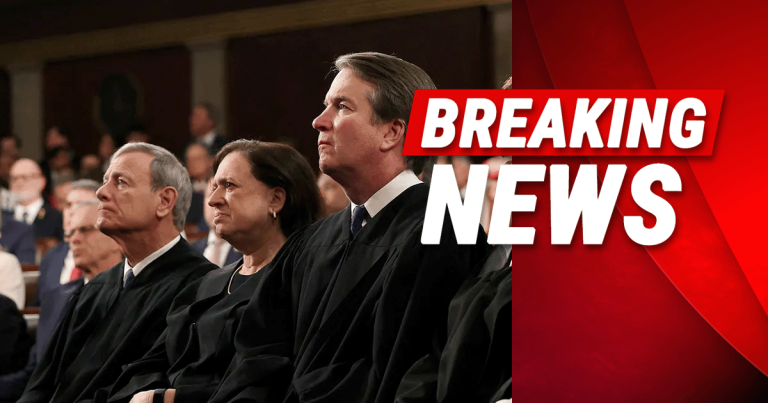
A seat on the United States Supreme Court is arguably the most consequential appointment in American government. These nine justices serve for life, shaping the boundaries of liberty, governance, and constitutional order for generations. When a president fills a vacancy based on judicial brilliance and fidelity to the law, the republic is strengthened. When a seat becomes a political token — awarded to check a campaign promise rather than to secure the sharpest legal mind available — the damage compounds quietly, then all at once.
That slow-motion erosion has been building since President Joe Biden openly pledged to nominate a justice based on race and sex rather than demonstrated excellence. This week, the bill came due — and it arrived in spectacular fashion.
From the Daily Caller:
Justice Samuel Alito tore into his colleague, Justice Ketanji Brown Jackson, for issuing a dissenting opinion on a procedural order that clears the way for Louisiana to redraw its unconstitutional congressional map ahead of its May 16 primary elections.
In a relatively unprecedented opinion relating to such an order, Justice Alito indirectly criticized Justice Jackson, stating, “The dissent in this suit levels charges that cannot go unanswered. The dissent would require that the 2026 congressional elections in Louisiana be held under a map that has been held to be unconstitutional.”
“Trivial at best.” “Baseless and insulting.” “Groundless and utterly irresponsible.” That’s not cable news commentary. That’s a sitting Supreme Court justice describing his own colleague’s legal reasoning — and honestly, it’s hard to argue with him.
Alito, joined by Justices Thomas and Gorsuch, dismantled Jackson’s objections with surgical precision. He posed a question she simply cannot answer: “What principle has the Court violated? The principle that Rule 45.3’s 32-day default period should never be shortened even when there is good reason to do so?”
Here’s what actually happened. The Court’s Rule 45.3 provides a standard 32-day window before a ruling is formally transmitted to the lower courts. That window gets shortened regularly — especially when both parties agree there’s urgency. In this case, Louisiana officials and the Callais plaintiffs both supported expediting the process. Only the Robinson appellants objected. Jackson wasn’t defending some sacred procedural safeguard. She was throwing a tantrum over a routine accommodation that nearly everyone involved had endorsed.
A lone voice for all the wrong reasons
Now, the most revealing detail. Justices Elena Kagan and Sonia Sotomayor — Jackson’s fellow liberal appointees, her natural allies on virtually every contested question — sided with the conservative majority. Jackson stood completely alone. When your own ideological teammates won’t even cosign your objection, that’s not principled dissent. That’s a flashing neon sign.
George Washington University law professor Jonathan Turley didn’t mince words either: “Justice Alito had had enough.” Turley noted that Jackson’s insistence on the 32-day waiting period amounted to delay “for no purpose, while the other parties had stated a reasonable and pressing need to finalize the opinion.” Translation: she wanted to stall for the sake of stalling. Not exactly the hallmark of a rigorous legal mind.
A pattern even her allies can’t ignore
If Monday’s clash were an isolated incident, you could chalk it up to a bad day. It isn’t. Since joining the Court in June 2022, Jackson has collected public rebukes from colleagues across the ideological spectrum like they’re merit badges. Justice Amy Coney Barrett, backed by five justices, chastised her for choosing a “startling line of attack” in the nationwide injunctions case. Justice Kagan broke from her in a free speech dispute that legal observers called “textbook.” And now Alito delivers the most blistering assessment yet: “It is the dissent’s rhetoric that lacks restraint.”
Then there’s the basic competence problem. Jackson incorrectly cited several past opinions in her Louisiana dissent. As the Daily Caller noted, instead of presenting arguments grounded in precedent and legal record, Jackson “appears to merely extol her own rhetorical skill and little more.” Eloquent writing is a fine gift. On the Supreme Court, it’s not a substitute for being right.
The question nobody in Washington wants to ask
Biden didn’t select Jackson from a pool of every qualified jurist in America. He selected her from a pool he deliberately narrowed by race and gender, fulfilling a promise made to shore up political support. Americans deserve to ask whether that process produced the most capable justice available. Jackson’s record is delivering the answer — loudly, repeatedly, and from the mouths of her own colleagues.
The Founders designed the Supreme Court as a firewall against political passion, a chamber where constitutional principle would outmuscle ideology and grandstanding. Every American, regardless of background, deserves justices who command the respect of their peers through legal precision — not theatrical dissents that even friendly justices refuse to join. When the nation’s highest bench becomes a performance stage, it isn’t just one justice who diminishes herself. It’s the republic itself.
Key Takeaways
- Justice Alito called Jackson’s lone dissent “trivial,” “baseless,” and “insulting.”
- Even liberal Justices Kagan and Sotomayor refused to join Jackson’s objection.
- Jackson’s growing pattern of rebukes from colleagues raises serious fitness-for-bench questions.
- Biden’s identity-based selection process continues to erode the Court’s credibility.
Sources: Daily Caller, Fox News