
For years, unelected federal judges have been in the business of redrawing America’s congressional maps — not based on communities of interest or geographic common sense, but on the color of voters’ skin. The Voting Rights Act, one of the most consequential pieces of legislation in American history, became a weapon for courts to override elected state legislatures and impose racially engineered districts. That was never the point of the law. But it sure was convenient for the people benefiting from it.
Now the legal ground is shifting beneath their feet. The Supreme Court’s recent 6-3 ruling in a Louisiana redistricting case upended the entire playbook, declaring that the Voting Rights Act does not compel states to create additional majority-minority districts. States that were strong-armed by activist courts are finally fighting back. And this week delivered the most decisive victory yet.
From The Post Millennial:
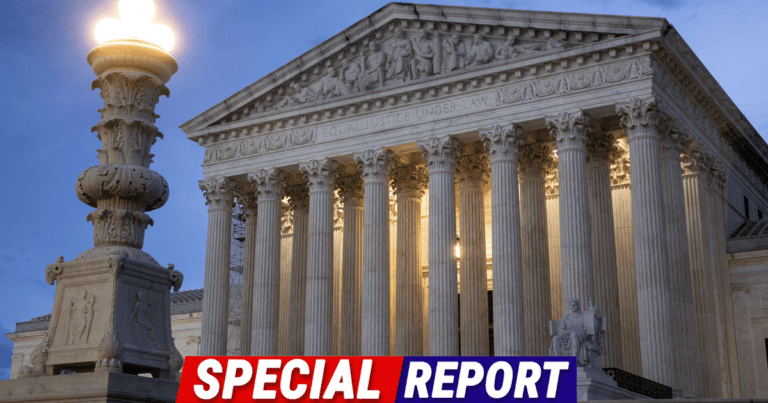
The Supreme Court has granted a request from Alabama Republican leaders to lift a block on the state using a congressional map adopted by the legislature in 2023. This comes after the court ruled in late April that a Louisiana map that was ordered to be made with a second black-majority district was an “unconstitutional racial gerrymander.”
The unsigned order vacates a US District Court ruling on the matter and hands the case back to the US Court of Appeals for the Eleventh Circuit for further consideration in light of the Louisiana decision.
This is a resounding win for Alabama, for constitutional governance, and for every American who believes the law should treat people as individuals — not as racial categories on a redistricting spreadsheet. The Supreme Court wiped away the lower court ruling that had forced Alabama to use a judicially imposed map with two majority-minority congressional districts instead of the single one the legislature drew.
Here’s the part that deserves a closer look. That court-imposed map wasn’t some dispassionate exercise in fairness. It directly manufactured the district that elected Democratic Rep. Shomari Figures. A federal judge drew the lines. A Democrat won the seat. Convenient, right?
Alabama Attorney General Steve Marshall captured the stakes perfectly in his emergency filing: “Americans, no less in Alabama, deserve a republic free of racial sorting now, and state officials deserve an opportunity to give it to them.”
Racial sorting. That phrase should hang in the air for a moment. Because that is precisely what federal courts were doing — and what the Supreme Court has now begun to unravel.
The Louisiana domino falls on Alabama
None of this happens without the Louisiana case. In that 6-3 decision, the Supreme Court’s majority stated clearly that the Voting Rights Act “did not require Louisiana to create an additional majority-minority district.” A lower court had previously forced Louisiana to redraw its map with a second Black-majority district. The parallels to Alabama were obvious to everyone paying attention.
Alabama moved fast. The state’s opponents tried to carve out an exception. The Court’s three liberal justices argued in dissent that Alabama involved a separate finding of “intentional discrimination,” making it legally distinct from Louisiana. The majority didn’t buy it. Nor should they have. The constitutional principle doesn’t bend based on which state you’re talking about. You don’t draw district lines by race. Period.
States reclaim their maps
Governor Kay Ivey wasn’t about to sit around waiting for permission. She called a special legislative session, and Alabama lawmakers passed redistricting legislation with impressive speed. Ivey signed it into law on Friday, alongside a measure authorizing special elections for any districts affected by the restored map.
“Alabama knows our state, our people and our districts best,” Ivey declared. A straightforward assertion of federalism — the kind of statement that shouldn’t be remotely controversial but somehow feels radical in 2026.
The state even offered to hold a special primary closer to November to ease any transition concerns. The NAACP predictably objected, pointing to overseas ballots already mailed for the May 19 primary. Alabama’s flexibility undercut those complaints before they gained any real traction.
And it’s not just Alabama. That same week, Virginia’s Supreme Court tossed out a Democrat-drawn congressional map for ignoring proper procedures. From the Deep South to the Old Dominion, the pattern is impossible to ignore.
A republic, not a racial headcount
What happened this week transcends a single state or congressional seat. It represents something more fundamental — a reassertion that in a constitutional republic, elected representatives draw the maps. Not federal judges wielding racial quotas. Not partisan operatives hiding behind civil rights language to gerrymander themselves into power.
The Supreme Court is restoring that balance. States like Alabama are answering the call with speed and conviction. The people draw the maps — not the judges. And not a moment too soon.
Key Takeaways
- The Supreme Court cleared Alabama to use its legislature-drawn map, vacating a lower court’s race-based mandate.
- The ruling builds on a 6-3 Louisiana decision limiting courts’ power to force majority-minority districts.
- Governor Ivey and Alabama lawmakers acted decisively, proving conservative state leadership delivers results.
- The tide against judicial redistricting overreach is turning — Alabama won’t be the last.
Sources: The Post Millennial, The Hill